
Greener View Newspaper Articles
Indoor Vegetable Growing
By JEFF RUGG
RELEASE: WEDNESDAY, Nov 29, 2023
Indoor Vegetable Growing
Q: The house we just moved to has a huge sunroom. I have had a small veggie garden in the past but this sunroom seems to have so much potential for growing vegetables over the winter in pots. I have never had much success with houseplants and have never tried a vegetable indoors. What tips can you give me?
A: Since it sounds like this is a new room to you, I wonder if it is heated and I wonder how you will handle water and drainage. Is this a separate room you get to with doors or is it an open part of the house? In other words, will it stay warm like the house or will you need to heat it separately? It may be easy to carry water into the room to water plants but where will the water go if it spills out of the trays under the plants? Will the floor be damaged? Is the floor concrete, tile, or wood?
My last question about the room is how much light is there in the room? Are there only large windows on the walls or are there also skylights? Are there any electric lights to supplement the sunlight? If there aren’t skylights there may not be enough light to grow vegetables once you move a few feet away from the windows. Indoor bright light is not the same thing as full sun. Winter days are shorter than summer days so having lamps on timers that can start the lights early in the morning and run later in the evening may help.
Many types of houseplants will grow in sunrooms but the vast majority of vegetable plants require full sun for most of the day, warm temperatures, and moist soil most of the time. If they don’t receive enough light or warm enough temperatures they will grow slowly and not produce many fruit. If they are dry out too often, they will drop their flowers and fruit.
If you are still thinking this will work, let's move on to the pots. Most people will use flower pots that are too small. A single tomato plant will need at least a pot the size of a five-gallon bucket. You might get two peppers in a pot that size. Any of the vines like zucchini or cucumber will need a large pot.
Normal potting soil for houseplants will work fine and it may include a small amount of fertilizer. Don’t use garden soil in the pots. A drainage hole in the pots will prevent too much water from remaining in the soil. The plants will not be growing as much as they would outdoors so they won’t need as much fertilizer.
The best plant varieties to try would be smaller plants that are labeled dwarf, compact, or determinate. Determinate plants grow to a set size, stop growing, then produce flowers and fruit. Indeterminate plants produce flowers and fruit over a long time and on a much larger plant. Look on the plant description for plants that bear crops sooner than others of their kind. A tomato that bears in 90 days is better than one that bears in 120 days. Indoors they may take longer than usual to grow because of the lower light and lower temperatures so faster fruit production may still get a crop this winter. A longer bearing plant may not grow long enough to bear fruit.
Since this is your first attempt, try just a few kinds of crops and a few of each one. See what works the best for you and expand next year.
E-mail questions to Jeff Rugg at info@greenerview.com.
New Hardiness Zone Map
By JEFF RUGG
RELEASE: WEDNESDAY, Nov 22, 2023
New Hardiness Zone Map
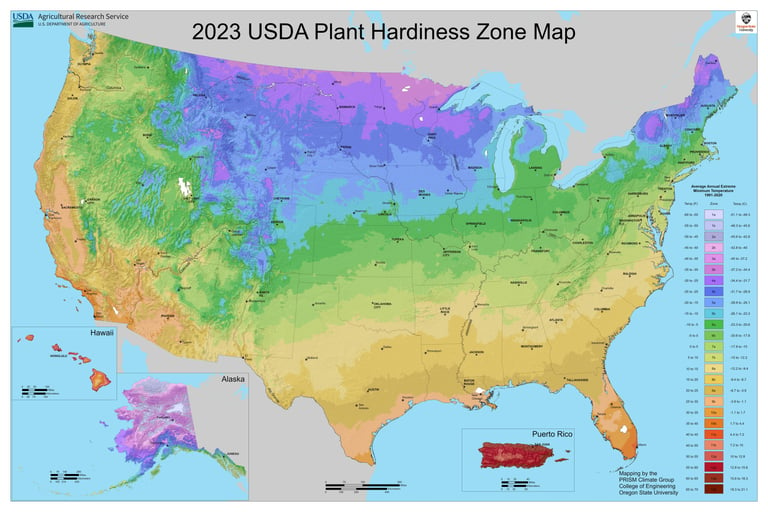
Last week the United States Department of Agriculture (USDA), released a new plant hardiness zone map for the United States. Does the new USDA map offer proof that the climate is warming? No, it does not. Do temperatures shift warmer and colder over time? Of course, they do. The temperatures over large regions fluctuate and hopefully always will. Just like the previous USDA map released in 2012, the new USDA map does not represent the new normal for climate.
The USDA website notes: "Climate changes are usually based on trends in overall average temperatures recorded over 50-100 years. Because the (new map) represents 30-year averages of what are essentially extreme weather events (the coldest temperature of the year), changes in map zones are not reliable evidence of whether there has been global warming."
Short-term weather is not the same thing as climate. Measuring only one aspect of weather for the short time frame of only a few decades is not reliable evidence of climate change.
There have been cold hardiness zone maps since Alfred Rehder published one in 1927. In 1960, 1965, and 1990 the USDA produced maps. Each map update used more recent temperature data, rather than adding to the existing data to create a longer-term map.
The 1990 USDA map looked at 14,500 locations but only used 8,000 weather stations that had valid data, which was twice as many as the previous maps. The 1990 USDA map used the average minimum temperature for the 13 years between 1974 and 1986. The 1990 map showed much of the country as being a zone or more COLDER than the 1965 USDA map. The 1965 map used data from a short warmer period of years and the 1990 map used data from a short colder range of years.
The 2012 USDA map looked at 8,000 stations, over the 30 years of 1976-2005, and it looks a lot like the 1965 USDA map. The 2023 map used data from 13,625 weather stations from the years 1991 through 2020. A sophisticated algorithm created map information taking into account topography and coastal effects between weather stations. This map averages about a quarter of a zone warmer than the 2012 map.
Average weather is made up of highs and lows. Taking a small sampling of data could taint the data to one end or the other. If we did maps one year at a time, sometimes we would have very warm maps and sometimes very cold ones. The temperature change between two years could appear to be abrupt. A longer look at the data would yield slower changes. Each of these USDA maps has dropped older data instead of using it. This can create the appearance of rapid changes when old data is dropped.
The trees and shrubs that most people use the zone maps for, live far longer than a decade or two, so maps developed from short-term data can be misleading to gardeners. All of the cold hardiness zone maps use the AVERAGE annual minimum temperature during the data collection period. This is not the same as the COLDEST minimum temperature that occurred each year during that time. Plant long-lived plants based on the coldest temperatures in your area, not the average minimum.
E-mail questions to Jeff Rugg at info@greenerview.com.
Thornless Blackberry? and Leaf Tips Dying
By JEFF RUGG
RELEASE: WEDNESDAY, Nov 15, 2023
Q: I was cleaning up my thornless blackberry row and I came across several very thorny stems. Do blackberry plants revert back to being thorny and not thornless? The rest of the plants seem to have the normal amount of stems coming up from the ground. What would be the best way to get rid of them without damaging the thornless plants?
A: I suppose it is possible to have thorny stems arise from the normally thornless plant, since that is probably the opposite of how we got thornless plants in the first place.
I think it is also possible that there are thorny plants growing nearby, maybe even in a wild setting. Birds that eat the fruit from that thorny plant would then find your thornless plants producing fruit at the same time. At some point, the bird might poop out the seeds from the thorny plant while visiting your plants. The seeds then grew in your garden. Many weed shrubs come up in hedges due to birds dropping seeds in the hedge.
Dig gently around the thorny plant stems with a hand trowel to see if the thorny stems are attached by roots or underground stems to the thornless plants. If they are then it is a thorny stem genetic variation. If they are separate plants, it is more likely to be a seedling plant.
Q: The tips of the leaves on several of my houseplants are dying. A couple of plants have dry dead edges along the sides of the leaf. Any thoughts on what I might be doing wrong?
A: There are four common reasons for the dead leaf tips and leaf edges on houseplants. First, not enough water. When the plant roots can’t get enough water, the leaf tips and edges are the farthest from the roots and they get the least amount of water. This is a common problem when the plants are watered inconsistently. When the plant gets watered, the parts closest to the roots get water faster and longer than the parts farthest from the roots.
Second, hot dry air blowing on the plant or just plain low humidity in the house can cause the leaf edges to dry out. Raising the humidity of the whole house is better for the plants and wooden furniture in the house. Adding water to trays under the plants doesn’t work all that well.
Third, Too much fertilizer may have been used. Fertilizer chemicals move through the plant and accumulate at the leaf tip and edges. Eventually, there is too much of these chemical salts in the cells along the edges and they die. This may be accompanied by white salt deposits accumulating on the top of the soil and along the edge of the pot. Scoop the salt off the soil and pot and then flood the soil with clean water several times to rinse out some of the fertilizer.
Fourth, the water may have too many minerals, too much chlorine, too much fluoride, or be the wrong pH for that plant. If these are the problem, using rainwater or water that has been setting out for a day to allow the chlorine to evaporate can help.
Trimming the dead areas off the leaf will improve the appearance, but unless the cause is diagnosed and treated, the dead areas will come back.
E-mail questions to Jeff Rugg at info@greenerview.com.
Chrysanthemums and Tulips
By JEFF RUGG
RELEASE: WEDNESDAY, Nov 8, 2023
Q: I love chrysanthemums. I buy several colors of them each fall. I have tried planting them in the ground but they have never come back in the spring. Any suggestions?
A: There are several reasons that they don’t make it through the winter. First, you need to buy a hardy variety. There are around twenty species of mums and thousands of varieties. The different species may be cold hardy from zones 7 to 4 in the north and as far south as zone 9. If you live in zone 5 and plant a mum only hardy to zone 6 it is possible that it will die over the winter. Some of the prettiest mums are called florist mums and they are the least hardy, maybe to zone 7.
Second, to protect garden mums from winter damage, wait until the top has been killed by frost. Cut the dead top off at about two inches above the ground. After several hard frosts, cover the plant with six to eight inches of mulch. This stops the alternating freeze-thaw cycles that can kill the roots. Remove about half the mulch in the spring as the new growth begins to grow.
Third, the soil in the flower pot is probably very different from the garden soil. It is likely to just be peat moss and some bark chips or perlite. It will dry out very quickly. Winter air is very dry and even slight winds will dry off the soil. The mulch will help but if there is no snow cover, you may need to water the plants a few times over the winter.
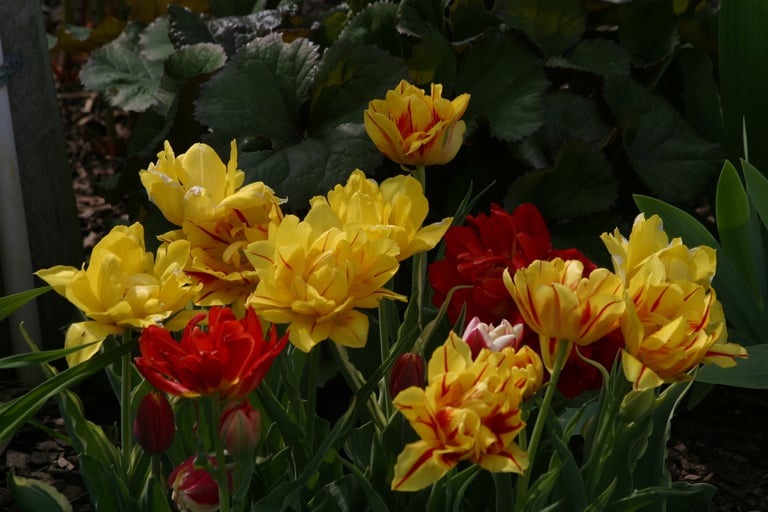
Q: Is it too late to plant flower bulbs like tulips? I bought them early but didn’t plant them yet. I don’t want to do all the work in the garden if they won’t grow. Can I pot them up and store them in the garage refrigerator for the winter and plant them in the spring?
A: Fall planted spring flowering bulbs grow roots when the ground temperature at bulb level is over 40 degrees. Even if the top of the soil is starting to freeze, larger bulbs like tulips and daffodils that are planted as much as 6 inches deep can still grow roots. Small bulbs like crocus that are planted in the top couple of inches may not be able to grow roots.
I once planted several species and many varieties of bulbs very late in the fall. There were varieties that were supposed to bloom in early, mid, and late spring. Since none of them grew roots in the fall, they did that in the spring and then they all bloomed at once in late spring.
For most gardeners in northern areas, it is better that the bulbs are in the ground in the fall, even if planted late. Southern gardeners who don’t have cold enough winters to give the bulbs proper growing conditions may buy the bulbs in pots in the spring. Those pots have been kept in refrigerators over the winter.
You can do this yourself. Plant the bulbs in pots with normal potting soil for house plants. The wider the pot the better. We don’t need a lot of roots like we would for a houseplant so a shallow wide pot allows more bulbs to grow in the pot for a better display of flowers in the spring. You can plant large bulbs near the bottom of the pot and small bulbs above them so that there are two levels of flowers. You can plant small bulbs on one side and large bulbs on the other side for a one-sided display. You can plant one kind of bulb in each pot so that as a pot comes into bloom it can be added to the display and as it goes out of bloom it can be removed from the display of flower pots.
After it is potted up, water the soil. Since refrigerators dry out everything that is in them it is a good idea to place the pot in a sealed plastic bag. After at least 90 days take the pots out and let the plants grow in a bright but cool location. You need to give them spring weather conditions, not hot summer conditions for the best flower display.
E-mail questions to Jeff Rugg at info@greenerview.com.